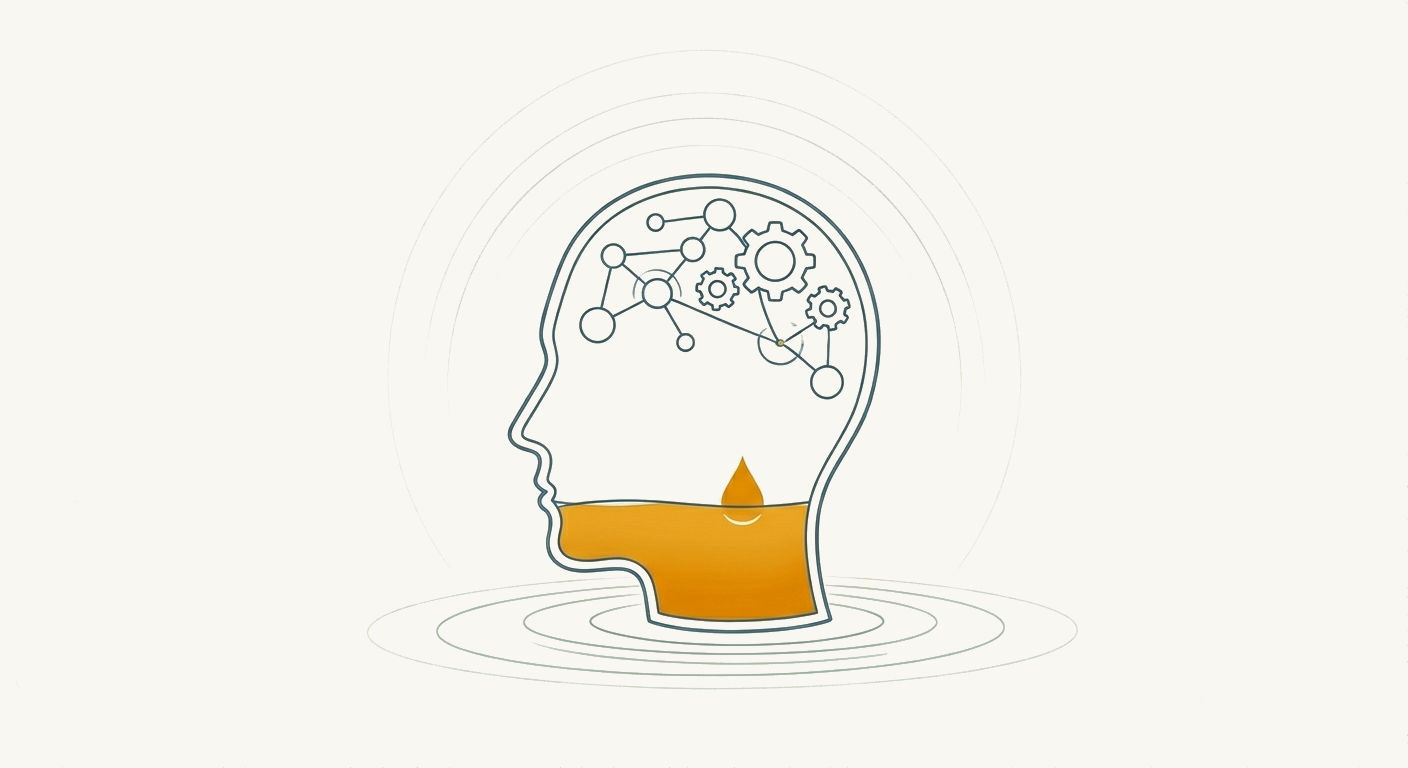
A Genuine Effect, Often Overstated
The relationship between hydration and cognitive performance is real, well-documented, and frequently overstated in wellness content. Mild dehydration does impair cognition. The effect is not as dramatic as some content suggests, it occurs at lower thresholds than most people expect, and the practical prescription that follows from the evidence is more nuanced than "drink 8 glasses a day."
What the Research Shows
Multiple controlled dehydration studies show measurable cognitive impairment at fluid losses of 1–2% of body weight, a level that can be reached through exercise, heat, or simply not drinking for several hours. At this threshold, the cognitive effects are concentrated in:
- Sustained attention, focus degrades faster on continuous tasks
- Working memory, modest impairment, particularly on tasks requiring information maintenance
- Processing speed, reaction times increase
- Mood, fatigue, tension, and anxiety ratings increase even before thirst is felt
An important caveat: some studies showing cognitive benefits from drinking water may be partially confounded by the cognitive benefits of correcting mild dehydration, not necessarily from exceeding optimal hydration. Over-hydration does not produce cognitive enhancement; restoring euhydration from a mildly dehydrated state does.
What's Actually Happening in the Brain
The brain is roughly 75% water by weight. At fluid losses of around 2%, MRI studies show measurable reductions in total brain volume. Not dramatic, but enough to alter function. The prefrontal cortex, which handles working memory and sustained attention, appears to be disproportionately sensitive. It's metabolically expensive tissue, highly dependent on consistent blood flow and glucose delivery.
Electrolytes matter here too. Sodium and potassium gradients are what allow neurons to fire. When fluid balance shifts, these gradients become less stable, which affects signal propagation. Mood effects like fatigue, tension, and reduced motivation often appear before the working memory effects do, possibly because the systems governing emotional state are affected at lower thresholds than the prefrontal cortex.
One finding that surprises people: the thirst mechanism is reliable, but it lags behind impairment. Ganio et al. (2011) found women showing degraded attention and mood at 1.36% dehydration, well before they reported significant thirst. Lieberman's group found similar results in both sexes. By the time you're noticeably thirsty during a cognitive task, you've probably already been running slightly below capacity for a while.
Discover Your IQ Score
Free 36-question assessment. Instant results. No sign-up required.
Take the Free IQ Test →The "8 Glasses a Day" Problem
The "8 × 8" rule (eight 8-ounce glasses per day) has no specific scientific basis. Hydration needs vary substantially by body size, physical activity, ambient temperature, diet (foods contain significant water), and health status. A sedentary person in a cool climate with a water-rich diet needs less than an active person in summer heat with a dry diet.
The most evidence-based guidance from organisations including the Institute of Medicine is to use thirst as a primary guide (it is a reliable signal in healthy adults who are not exercising intensely or in extreme heat) and to monitor urine colour, pale yellow indicating adequate hydration, dark yellow or amber indicating underhydration.
Who's Most Vulnerable
Individual sensitivity varies more than most people realise. Children and older adults both show stronger cognitive effects from the same percentage of fluid loss, children because their thirst sensitivity is lower and their thermoregulatory system less mature, older adults because the thirst response genuinely weakens with age and kidney efficiency declines. This isn't a minor difference: a 70-year-old can be meaningfully dehydrated without feeling particularly thirsty.
Physical fitness doesn't protect against the cognitive effects. Athletes develop more efficient thermoregulation (they sweat earlier and cool faster), but the dehydration threshold at which attention and working memory start to degrade appears to be about the same regardless of aerobic fitness. What changes with fitness is how long it takes to reach that threshold during exercise, not the threshold itself.
Practical Implications for Cognitive Performance
For cognitive assessments or sustained mentally demanding work:
- Ensure you are not arriving dehydrated, drink water consistently in the hours before, not just immediately before
- Do not rely on thirst during the task itself, cognitive load can suppress thirst awareness
- If you have exercised or been in heat beforehand, explicit rehydration before sitting down to think matters more than usual
- Coffee and tea count toward hydration despite caffeine's mild diuretic effect, the net hydration balance is positive for typical doses
Hydration is not a cognitive enhancer in the supplement sense, you cannot drink your way to higher IQ. But mild dehydration is a common, easily corrected performance impairment that costs nothing to address. It belongs on the checklist for performing at your cognitive best, alongside sleep and a normal nutritional state.

AJ Dorey
Founder, IQScore
AJ Dorey is an English software developer who researches and writes about intelligence and cognition. He built IQScore because most online IQ tests are broken — they either inflate scores to keep people happy or bury results behind a paywall after 20 minutes of questions.
Curious where you actually rank?
Free IQ test · 36 questions · Instant results · No sign-up
Start Free IQ Test →Already know your score? Convert it to a percentile →