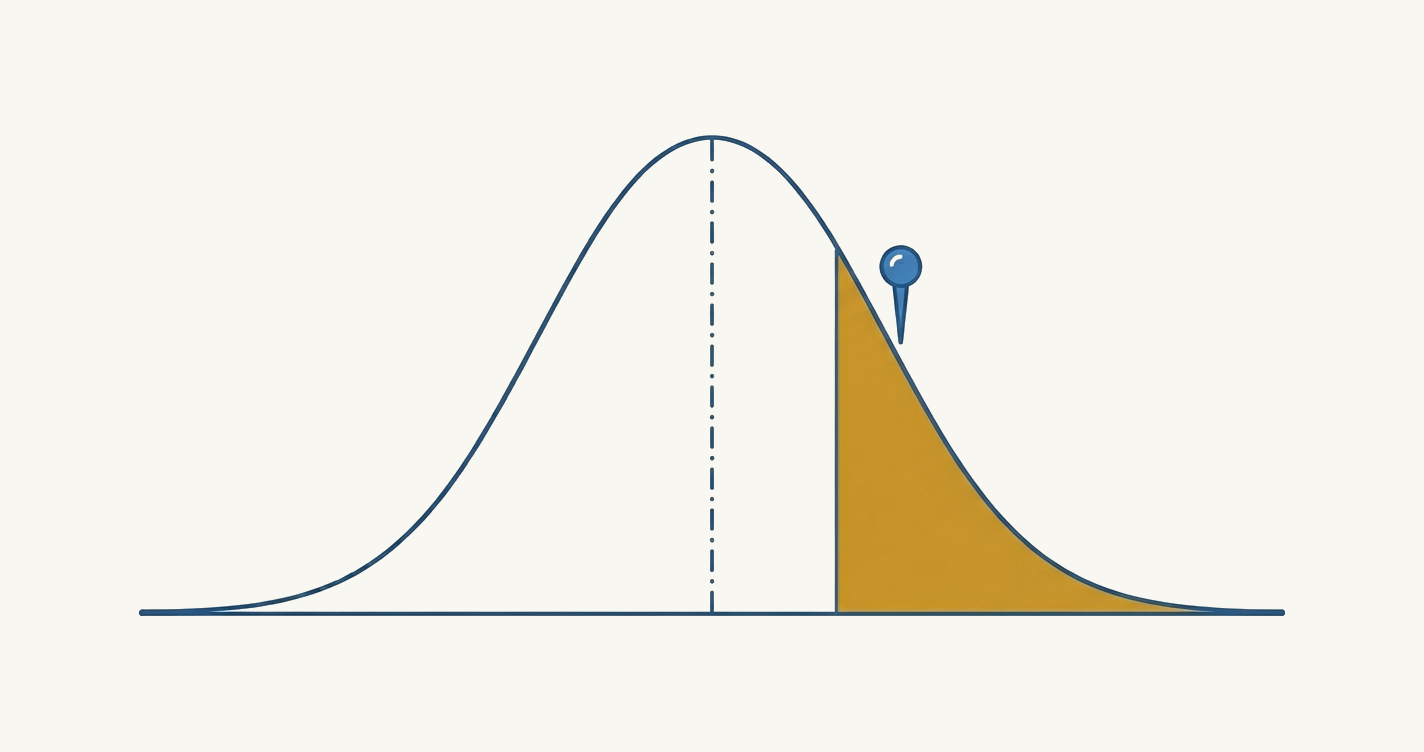
What Your IQ Score Tells You
Most people who see their IQ score for the first time react in one of two ways: relief or deflation. Both reactions are usually based on the same misunderstanding.
A "good" IQ score is anything above 100, because 100 is the population average by design, not by coincidence. If you have recently taken an IQ test on IQScore, or are considering one, here is exactly what your score tells you.
Why 68% of the Population Scores Between 85 and 115
IQ tests are constructed to produce a normal distribution, the familiar bell curve, with a mean of 100 and a standard deviation of 15. That is a design feature, not an empirical discovery.
What matters is not your raw score but where you fall relative to everyone else. That is the only figure carrying real information about your cognitive standing.
The 6 IQ Score Bands: What Each One Means
Context Is Everything: When 110 Beats 130
For theoretical physics or highly selective academic programmes, 115 may not feel exceptional. For most careers, skilled trades, creative work, business, leadership, any score in the average-to-high-average range carries no meaningful cognitive ceiling on what you can achieve.
An IQ score is a snapshot of specific cognitive abilities measured under specific conditions on a specific day. It is not a verdict on your worth, your potential, or your ceiling.
IQ correlates with academic performance, job performance in cognitively complex roles, and life outcomes including health and income. These correlations are real. But conscientiousness, emotional intelligence, social skills, creativity, and persistence all contribute to success in ways IQ does not capture, and in many contexts they matter considerably more.
Where does your score land on the bell curve?
Find out in under 25 minutes. Free, no sign-up, instant results with a full cognitive domain breakdown.
Take the Free IQ Test →The Flynn Effect: Why IQ Scores Have Risen 30 Points in a Century
One of the most striking findings in intelligence research is the Flynn Effect, documented by philosopher James Flynn. Average IQ scores rose by roughly three points per decade across much of the twentieth century, populations now score the equivalent of 30 points higher on the same raw questions their great-grandparents faced.
The causes are genuinely debated. Leading candidates: improved nutrition, greater access to formal education, more cognitively stimulating environments, and greater familiarity with abstract reasoning, exactly the kind IQ tests demand. Whatever the cause, the Flynn Effect proves that measured IQ responds dramatically to environmental conditions. Tests are periodically renormed to keep the mean at 100, which is why a score of 100 in 1960 and a score of 100 today represent different absolute levels of raw performance.
The Limits of IQ Testing
A critical distinction that gets glossed over in popular coverage: IQ is not intelligence. IQ tests measure a specific set of cognitive abilities, primarily fluid reasoning, working memory, processing speed, and verbal comprehension. They do not measure:
- Creativity and artistic or musical ability
- Emotional intelligence and social skill
- Practical wisdom and judgment
- Spatial navigation, naturalistic intelligence, or bodily-kinaesthetic ability
- Drive, persistence, and motivation, which research consistently shows matter more than IQ in long-term outcomes
The score tells you something real and useful. It does not tell you everything, and treating it as though it does is a mistake.
How to Use Your Score Productively
If you scored below your expectations: Resist treating the number as a ceiling. Working memory improves with targeted training. Processing speed responds to practice. Vocabulary, a significant factor in verbal IQ, grows with reading at any age. The score you receive today is not a fixed characteristic of your mind. If you are unsure whether an online test is the right tool, our guide to free vs paid IQ tests explains the differences.
If you scored above average: Raw cognitive ability without discipline and directed effort produces very little. Research on exceptional performance consistently shows that deliberate practice in a specific domain matters more than baseline IQ once you clear a basic competence threshold. The high scorers who accomplish the most are not the ones who coast on ability.
Treat your IQ score as one data point among several. Use it to understand your cognitive strengths, identify areas worth developing, and calibrate your expectations. Then act on the information.
The Bottom Line
A good IQ score is, by definition, one above 100. A strong score is above 115. An exceptional score is above 130. But the number is only a starting point. The most accomplished people in any field are rarely the highest scorers on a standardised test, they combine cognitive ability with persistence, genuine curiosity, and the willingness to keep working at hard problems.
Take the free IQ test and get the most accurate baseline data point available, then use it.

AJ Dorey
Founder, IQScore
AJ Dorey is an English software developer who researches and writes about intelligence and cognition. He built IQScore because most online IQ tests are broken — they either inflate scores to keep people happy or bury results behind a paywall after 20 minutes of questions.
Further Reading
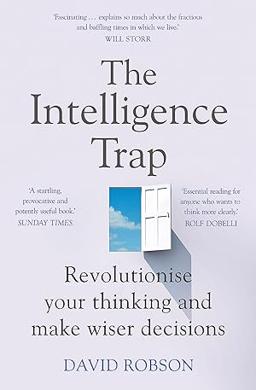
The Intelligence Trap
David Robson
The Intelligence Trap investigates why high IQ consistently fails to prevent poor decisions, motivated reasoning, and costly mistakes. If this article made you wonder what your score actually means for your life, this is the most important follow-up read.
Curious where you actually rank?
Free IQ test · 36 questions · Instant results · No sign-up
Start Free IQ Test →Already know your score? Convert it to a percentile →