
The Problem With Most IQ Test Prep Advice
Search for "how to prepare for an IQ test" and you will find two categories of advice: generic tips that apply to any test (sleep well, eat breakfast, arrive early), and specific pattern practice that improves familiarity with test formats without reliably increasing underlying cognitive performance. Neither is completely useless. Neither will dramatically change your score.
The honest starting point is this: IQ tests are specifically designed to resist short-term preparation. Their format, novel reasoning tasks, pattern recognition problems you have not seen before, is intended to measure something more stable than test-taking skill. The test designers are, in a sense, your adversary in the preparation game. Understanding that dynamic is the first step to preparing intelligently.
What Helps: The Physiology
The interventions with the clearest evidence for improving cognitive test performance are physiological, not cognitive:
- Sleep, the highest-leverage variable. A single night of full sleep (7–9 hours) before a cognitive assessment has a measurable positive effect on working memory, processing speed, and sustained attention. Chronic partial sleep restriction (6 hours/night for a week) impairs performance in ways that cannot be overcome by motivation or caffeine. If you have one thing to optimise before a test, it is sleep the night before, and ideally the two nights before.
- Aerobic exercise, acute and cumulative effects. A 20–30 minute moderate aerobic workout 60–90 minutes before a cognitive test produces measurable improvements in attention, working memory, and processing speed. If your test is in the morning, a brisk walk or light jog before you sit down has solid evidence behind it.
- Nutritional state. Do not test in a significantly depleted state, several hours of fasting before a demanding cognitive task tends to impair performance. A normal meal 2–3 hours before testing is sufficient. Avoid large meals immediately before (blood flow shifts to digestion) and heavy sugar loads (glucose spike followed by dip).
~8 pts
Typical IQ score difference between well-rested and significantly sleep-deprived performance in the same individual
Discover Your IQ Score
Free 36-question assessment. Instant results. No sign-up required.
Take the Free IQ Test →Format Familiarity: Limited But Real
Practising on IQ-style questions does help, but primarily with format familiarity rather than underlying cognitive capacity. Someone who has never seen a matrix reasoning problem before may waste time figuring out what the question is asking rather than actually solving it. Someone familiar with the format directs their cognitive resources immediately to the problem itself.
The benefit of format practice is real but has a ceiling. After roughly 4–6 hours of practice on a given question type, most people have extracted most of the available familiarity benefit. More practice beyond that is increasingly unlikely to produce further score gains on genuinely novel problems.
Useful practice areas: matrix reasoning (pattern completion), number series, verbal analogies, and spatial rotation tasks. Free resources for each are widely available online, search for "Raven's Progressive Matrices practice" or "IQ test sample questions" to find representative material.
The Day-Of Checklist
- Full sleep the night before (7–9 hours, this is non-negotiable for peak performance)
- Light aerobic activity in the morning if testing midday or later
- Normal meal 2–3 hours before, not immediately before
- Avoid alcohol for at least 24 hours prior, its effects on processing speed persist well beyond intoxication
- If caffeine is habitual, maintain your normal dose to avoid withdrawal impairment; do not substantially increase it
- Test in a quiet, distraction-free environment, even the presence of a phone nearby measurably reduces available cognitive capacity in working memory tasks
- Take your time on each question but do not spend more than 60–90 seconds on any single item, strategic time management matters on timed assessments
Managing Test Anxiety
Test anxiety specifically impairs the cognitive resources that IQ tests demand most. The mechanism is not just general arousal, anxious rumination consumes working memory capacity. A portion of your working memory bandwidth gets allocated to monitoring the threat ("am I doing badly?", "what if I fail?") rather than solving the problem in front of you. Research by Sian Beilock at the University of Chicago found that high-working-memory individuals are actually more susceptible to test anxiety's cognitive impact than low-working-memory individuals, paradoxically, because they have more capacity to ruminate.
The most evidence-based acute intervention for test anxiety is expressive writing: writing freely about your anxieties for 10 minutes immediately before the test. Beilock's studies found this reduced performance decrements in anxious test-takers by partially offloading rumination from working memory onto paper. The intervention is simple, free, and takes less time than most preparation activities.
What Not to Do
- Cramming specific "IQ facts", there are no facts to memorise; the test measures reasoning, not knowledge
- Extensive preparation the night before, fatigue from late-night studying costs more than any marginal knowledge gain
- Excessive caffeine, anxiogenic effects at high doses impair precisely the working memory functions IQ tests measure
- Setting up a performance-anxiety mindset, your best result comes from treating it as a problem-solving session, not a high-stakes evaluation
The IQScore free IQ test is available any time, take it in your peak cognitive window (most people perform best mid-morning, 2–3 hours after waking), in a quiet environment, at full attention.

AJ Dorey
Founder, IQScore
AJ Dorey is an English software developer who researches and writes about intelligence and cognition. He built IQScore because most online IQ tests are broken — they either inflate scores to keep people happy or bury results behind a paywall after 20 minutes of questions.
Further Reading
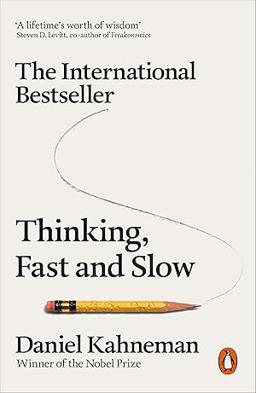
Thinking, Fast and Slow
Daniel Kahneman
Thinking, Fast and Slow is one of the most important books written on how the mind works, the two cognitive systems behind reasoning, decision-making, and performance under pressure. Well worth reading for anyone interested in their own cognition.
Curious where you actually rank?
Free IQ test · 36 questions · Instant results · No sign-up
Start Free IQ Test →Already know your score? Convert it to a percentile →