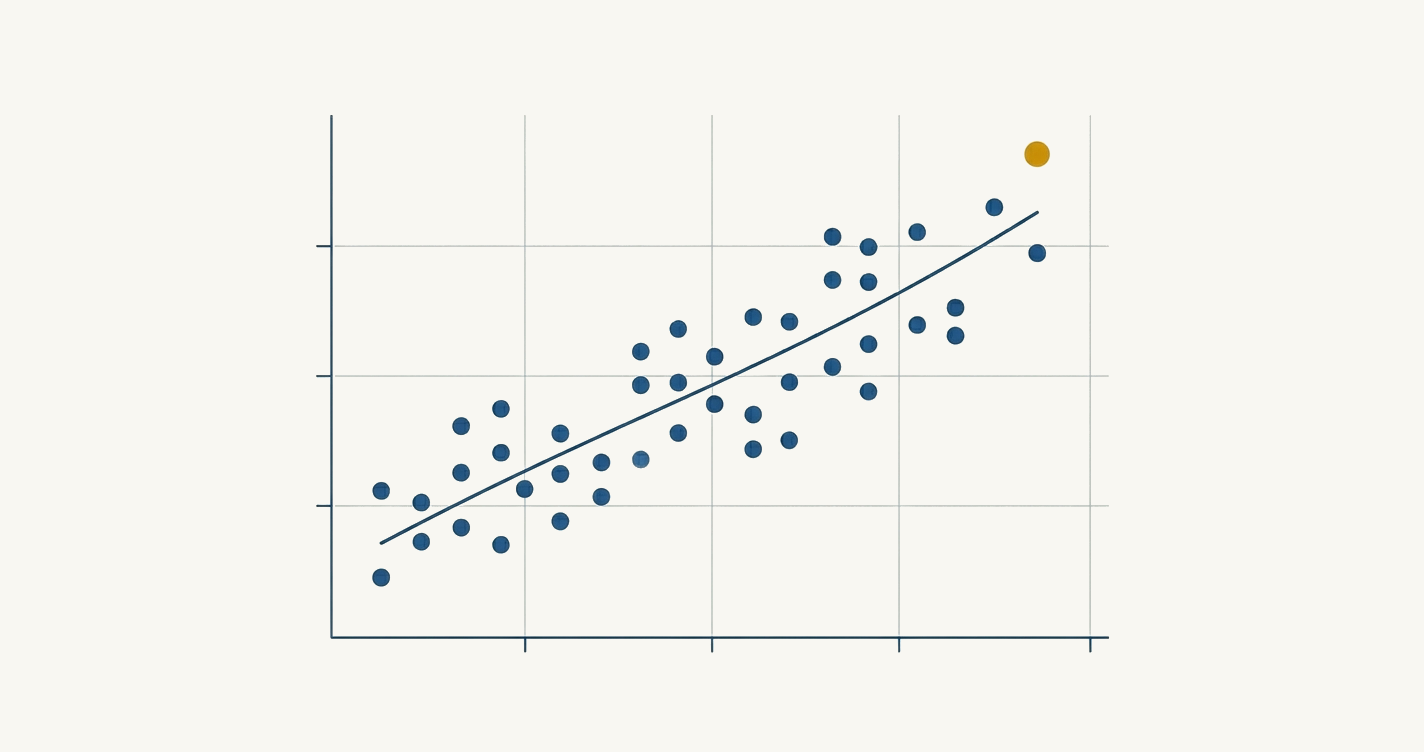
The Question Everyone Has But Rarely Asks Directly
It is one of the most consequential questions you can ask about intelligence: does being smarter lead to earning more? The answer from decades of research is yes, but with important qualifications that are usually omitted when this finding gets cited.
IQ does predict income. It also predicts educational attainment, job complexity, career advancement, and occupational prestige. What it does not do is determine any of those outcomes alone, and the size of the relationship shrinks considerably once you account for other variables that IQ itself predicts.
The Numbers
The most frequently cited figures come from large longitudinal studies in the United States and United Kingdom. The correlation between IQ and income in adulthood is typically reported between r = 0.30 and r = 0.40. In statistical terms, that means IQ explains roughly 9–16% of the variance in income, meaningful, but leaving 84–91% of the variance explained by other factors.
The relationship is stronger for career attainment than for raw income within a given job. IQ strongly predicts what kind of job you end up in; it predicts much less about how well you are paid relative to others doing the same job.
The data behind these figures comes primarily from three large longitudinal studies: the US National Longitudinal Survey of Youth (NLSY79), which tracked over 12,000 Americans from 1979 using military AFQT scores as the cognitive measure; the British Cohort Study, following roughly 17,000 people born in 1970; and various Scandinavian military datasets with near-complete population coverage. Herrnstein and Murray drew heavily on the NLSY79 in The Bell Curve (1994), arguing for a larger and more deterministic IQ-income relationship than most researchers now accept. Economist James Heckman published influential responses pointing out that when education and family background are included as controls, IQ's independent contribution shrinks substantially, and that childhood environment and skill formation explain much of what looks like raw cognitive ability in the data.
The Mediation Problem
Much of IQ's effect on income is mediated, it operates through education. Higher IQ leads to higher educational attainment, which unlocks higher-paying occupations, which produces higher income. When researchers statistically control for education, the direct IQ–income relationship shrinks substantially.
This does not mean IQ's role is illusory; it means its influence is partly structural. Your IQ affects which opportunities become available and accessible to you, not just how well you perform once you have them.
Discover Your IQ Score
Free 36-question assessment. Instant results. No sign-up required.
Take the Free IQ Test →Where IQ Matters Most (and Least)
The relationship between IQ and earnings is not uniform across the income distribution:
At the high end, other factors dominate: entrepreneurship, risk tolerance, social networks, luck, and domain-specific knowledge. Many of the wealthiest individuals in any economy are not the highest-IQ individuals. The correlation between IQ and net worth at the very top of the distribution is surprisingly weak.
In the middle, IQ is a stronger predictor. Occupational sorting means that most jobs above a certain complexity threshold require cognitive performance above a threshold, and IQ correlates strongly with whether you can sustain that performance.
Below a threshold, cognitive limitations do begin to constrain access to higher-complexity work in meaningful ways. This is where the relationship is most practically significant, not as a ceiling for the high end, but as a floor below which certain roles become genuinely harder to access.
What Predicts Income Better Than IQ?
Several factors show comparable or stronger relationships with lifetime earnings in large studies:
- Conscientiousness, the Big Five personality trait most consistently associated with occupational performance across all job types
- Social skills and network, particularly predictive for roles requiring negotiation, sales, or leadership
- Family background and social capital, still strong predictors independent of measured IQ
- Domain-specific expertise, accumulated knowledge that IQ facilitates but does not replace
- Risk tolerance and entrepreneurial behaviour, the dominant factor at the top of the wealth distribution
Does It Matter Where You Live?
One pattern in the data tends to get overlooked. The IQ-income relationship is not uniform across countries. In societies with stronger meritocratic educational access, IQ-to-income pathways are more direct because educational attainment more reliably follows cognitive ability. In countries with high income inequality and low social mobility, family background and inherited advantage predict income about as strongly as measured cognitive ability. The United States sits in an uncomfortable middle, higher inequality than most peer economies, but with enough meritocratic pathways that IQ still carries meaningful predictive weight. A measured IQ of 120 in Denmark is likely to translate into a professional career at a higher rate than the same score in a country with limited tertiary education access.
The Bottom Line
IQ is a real predictor of income, especially of occupational attainment, but it is one factor among many, and its influence is largely structural (operating through education and job access) rather than direct. A person with a 110 IQ and high conscientiousness, relevant expertise, and strong social skills will typically outperform a person with a 130 IQ who lacks those attributes.
Intelligence opens doors. What you do once you are through them depends on much more than what an IQ test measures.

AJ Dorey
Founder, IQScore
AJ Dorey is an English software developer who researches and writes about intelligence and cognition. He built IQScore because most online IQ tests are broken — they either inflate scores to keep people happy or bury results behind a paywall after 20 minutes of questions.
Curious where you actually rank?
Free IQ test · 36 questions · Instant results · No sign-up
Start Free IQ Test →Already know your score? Convert it to a percentile →