
The Finding That Upended How We Think About IQ
In the 1980s, political scientist James Flynn noticed something troubling in the IQ data. Across multiple countries, going back decades, raw test scores had been rising generation after generation, by roughly 3 IQ points per decade. The finding was so unexpected that it became known simply as the Flynn Effect.
Flynn himself was an unlikely discoverer. He was a New Zealander who taught moral philosophy and political science, not a psychologist. He came to the data while researching racial differences in IQ, initially trying to understand what the numbers meant, and noticed that the norming dates on IQ tests told a story nobody had assembled into a complete picture. He spent decades building that picture, and the implications kept getting larger. Flynn died in December 2020, having spent the final decade of his life grappling with whether the effects he'd documented reflected genuine gains in human reasoning or something more superficial.
The implication is striking: if you took an IQ test standardised in 1930 and applied it today without renorming, the average person would now score approximately 130, a number that would classify them as "Very Superior" by historical standards. Conversely, if someone from 1930 took a modern test, the average score would land around 70.
This is not because people were unintelligent in 1930. It tells us something profound about what IQ tests actually measure, and what intelligence really is.
~30 points
Estimated IQ rise since the 1930s, equivalent to two full standard deviations
What Is Causing It?
The Flynn Effect is too large and too fast to be explained by genetics, natural selection simply does not operate on a timescale of decades. The causes are environmental, and researchers have identified several credible contributors:
- Better nutrition, Particularly in early childhood. Iodine deficiency alone is estimated to reduce IQ by 10–15 points; its elimination through iodised salt accounts for a measurable portion of the 20th-century gains. Reduced lead exposure following the removal of leaded petrol is another significant factor.
- Expanded education, Modern education systems specifically train the kind of abstract, hypothetical thinking that IQ tests measure. Flynn himself argued that the 20th century saw a shift from concrete, practical thinking toward abstract classification, exactly the skill measured by most test items.
- Smaller family sizes, The birth-order effect (earlier-born children tend to score slightly higher) combined with declining average family sizes may contribute a modest effect.
- Reduced infectious disease burden, Childhood illness diverts metabolic resources away from brain development. Lower disease rates, particularly in early childhood, free those resources.
- Greater cognitive stimulation, More visually complex environments, greater exposure to abstract problem-solving in daily life, and increased familiarity with test-taking formats.
What Rose, and What Didn't
Not all cognitive abilities improved equally, and the pattern is telling. Scores on non-verbal, abstract reasoning tests, particularly Raven's Progressive Matrices, rose dramatically. These test pure fluid intelligence: pattern recognition, novel problem-solving, identifying rules from instances. They require no prior knowledge and no language ability.
Vocabulary, general information, and arithmetic scores rose much less, or in some populations barely at all. This suggests the gains are not simply "people got smarter in every way." They got much better specifically at the abstract, hypothetical, context-free style of thinking that modern education and visual media actively train. Flynn called this shift a move from "concrete" to "scientific" spectacles, we now see the world through abstract categorical lenses our great-grandparents rarely used.
The developing world data adds another dimension. In many African, Asian, and Latin American countries, the Flynn Effect is still in full force, gains of 3-4 points per decade continue as nutrition, education, and healthcare improve. The reversal seen in Norway and similar countries represents a post-improvement plateau, not a global trend.
Discover Your IQ Score
Free 36-question assessment. Instant results. No sign-up required.
Take the Free IQ Test →The Reversal: The Anti-Flynn Effect
More recently, researchers in Scandinavia noticed something unexpected: the Flynn Effect appears to have stalled or reversed in several high-income countries. A 2018 study of Norwegian military conscripts by Bratsberg and Rogeberg found declining raw scores from cohorts born after 1975.
This reversal is not well understood. Proposed explanations include changes in educational approach (less emphasis on abstract reasoning), the cognitive effects of modern media consumption patterns, and the possibility that the low-hanging fruit of environmental improvement has already been harvested in wealthy nations.
What the Flynn Effect Tells Us About IQ
The most important lesson from Flynn's work is that IQ scores are not measuring some fixed biological property of the brain. They measure developed cognitive skills, skills that respond to environmental conditions, educational opportunities, and cultural norms around abstract thinking.
This is both reassuring and sobering. Reassuring, because it means the cognitive tools measured by IQ tests are genuinely malleable. Sobering, because it means test scores are always relative to a time, place, and norming sample, not an absolute measure of some platonic "intelligence."
All modern IQ tests are periodically renormed precisely to account for this drift. When you take a properly standardised test today, you are being compared to a contemporary sample, not to people tested fifty years ago.

AJ Dorey
Founder, IQScore
AJ Dorey is an English software developer who researches and writes about intelligence and cognition. He built IQScore because most online IQ tests are broken — they either inflate scores to keep people happy or bury results behind a paywall after 20 minutes of questions.
Further Reading
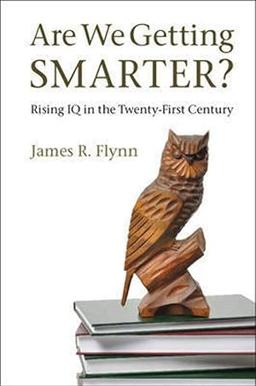
Are We Getting Smarter?
James Flynn
Are We Getting Smarter? by the researcher who documented the Flynn Effect is the definitive account of why IQ scores have risen so dramatically over the past century, and what it reveals about the nature of intelligence itself.
Curious where you actually rank?
Free IQ test · 36 questions · Instant results · No sign-up
Start Free IQ Test →Already know your score? Convert it to a percentile →