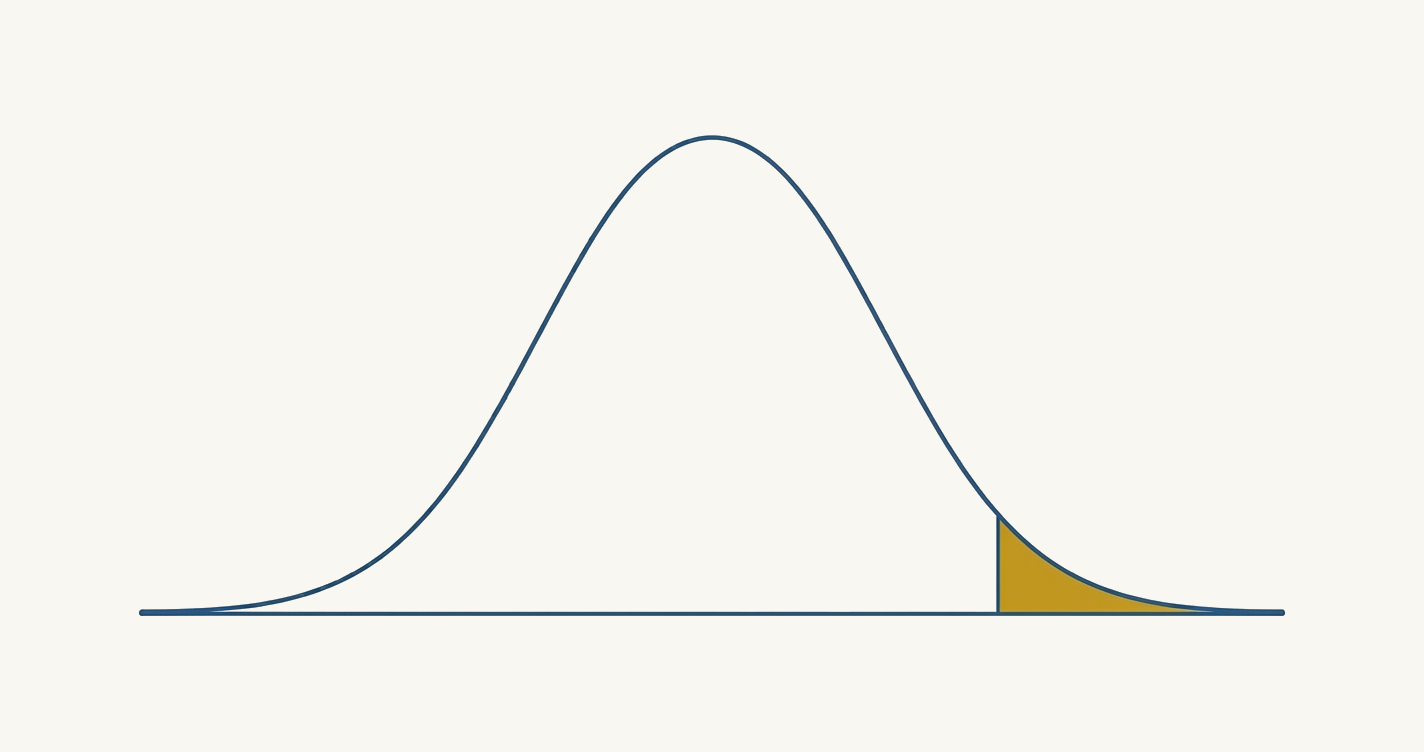
The 98th Percentile
Mensa International, the high-IQ society founded in England in 1946, has one qualifying criterion: scoring at or above the 98th percentile on an approved standardised intelligence test. There is no application process beyond the score, no interview, no assessment of achievement or character. If you score high enough, you qualify.
The 98th percentile translates to a score of approximately 130 or above on most IQ tests using the standard scale (mean 100, standard deviation 15). On the Stanford–Binet scale, which historically used a different standard deviation, the equivalent threshold was slightly different, but modern tests largely converge on the 130 figure.
Mensa was founded in Oxford in 1946 by Roland Berrill, an Australian barrister, and Lancelot Ware, a British scientist. Their original vision was ambitious: gather the world's highest-IQ individuals into a society that could advise governments and contribute solutions to global problems. That vision didn't last long. By the mid-1950s, Mensa had evolved into primarily a social club. The advisory ambitions were quietly dropped. It has been mostly a networking and social community ever since, which is worth knowing before you decide whether qualifying matters to you.
How Mensa Testing Works
Mensa accepts scores from two pathways:
Prior evidence, a qualifying score on an approved standardised test already on record. Mensa maintains a long list of approved tests including the WAIS, Stanford–Binet, SAT (with a score cutoff from years when the SAT was a better IQ proxy), GRE, and others. If you were tested as part of a psychological evaluation or school assessment and scored at or above the threshold, you may be able to submit that score.
Mensa's own supervised test: Mensa administers its own qualifying examinations, typically two tests given together, with a combined score used for qualification. The tests are not disclosed publicly, which prevents systematic preparation for the specific content.
What a Mensa Score Does and Does Not Mean
Qualifying for Mensa means you scored in the top 2% of the population on an IQ test on a particular occasion. That is a specific, limited claim.
It does not mean:
- You will achieve more than non-members: Mensa members are overrepresented in academic and professional success but far from uniformly so
- Your score is fixed, IQ scores are not perfectly stable and can vary with health, test conditions, and life circumstances
- You have been assessed on all dimensions of intelligence, a Mensa-qualifying score reflects primarily fluid reasoning and pattern recognition, not creativity, emotional intelligence, or practical judgment
Discover Your IQ Score
Free 36-question assessment. Instant results. No sign-up required.
Take the Free IQ Test →The Spread Below the Threshold
It is worth understanding what the percentile distribution looks like around the Mensa threshold:
- IQ 100 = 50th percentile (average)
- IQ 115 = 84th percentile
- IQ 120 = 91st percentile
- IQ 125 = 95th percentile
- IQ 130 = 98th percentile (Mensa threshold)
- IQ 145 = 99.87th percentile
The practical implication is that the difference between a 110 IQ and a 125 IQ, a gap that feels enormous in popular imagination, is the difference between the 75th and 95th percentile. Both are well above average; the person at 125 is simply at the higher end of an above-average range, not in a categorically different cognitive class.
Beyond Mensa
Mensa is the most famous high-IQ society but not the most exclusive. Several others exist with higher thresholds:
- Triple Nine Society, top 0.1% (approximately IQ 149)
- Prometheus Society, top 0.003% (approximately IQ 164)
- Mega Society, top 0.0001% (approximately IQ 176)
These societies are functionally tiny. The Prometheus Society has fewer than 100 verified members worldwide. At those thresholds, standard IQ tests hit ceiling effects, there aren't enough items at extreme difficulty to reliably differentiate scores, so measurement error becomes a substantial fraction of any given result. Psychologists who work with exceptionally gifted populations generally treat scores above 145 as imprecise indicators of "extremely high," not specific rank.
Research on whether extreme IQ levels produce proportionally greater outcomes is mixed. The SMPY study (Study of Mathematically Precocious Youth) tracked individuals at the 99.99th percentile and found they did produce significantly more patents and academic publications than those at Mensa level. There are real-world differences at extreme ability levels. They're differences of degree, though, not categorical transformation.
Should You Pursue Membership?
Mensa membership offers access to a community, local and national events, and for some people, a social environment where intellectual interests are shared. Whether that is worth the membership fees and the test preparation depends entirely on what you are looking for.
If you're serious about testing, the most comprehensive pathway is a full psychological battery, WAIS-IV or Stanford-Binet 5, administered by a licensed psychologist. It costs $200-400 but gives you a detailed cognitive profile across multiple domains, and the score is usable for clinical, educational, and employment purposes beyond just Mensa admission. Mensa's own supervised test is cheaper (around $40 in the US) and faster, but the result is only valid for Mensa qualification, nothing else.
The score itself, qualifying or not, is one data point about your cognitive profile. The IQScore IQ test gives you a starting estimate of where you stand before pursuing formal Mensa testing, and breaks down your performance by cognitive domain so you understand your profile, not just your number.

AJ Dorey
Founder, IQScore
AJ Dorey is an English software developer who researches and writes about intelligence and cognition. He built IQScore because most online IQ tests are broken — they either inflate scores to keep people happy or bury results behind a paywall after 20 minutes of questions.
Curious where you actually rank?
Free IQ test · 36 questions · Instant results · No sign-up
Start Free IQ Test →Already know your score? Convert it to a percentile →