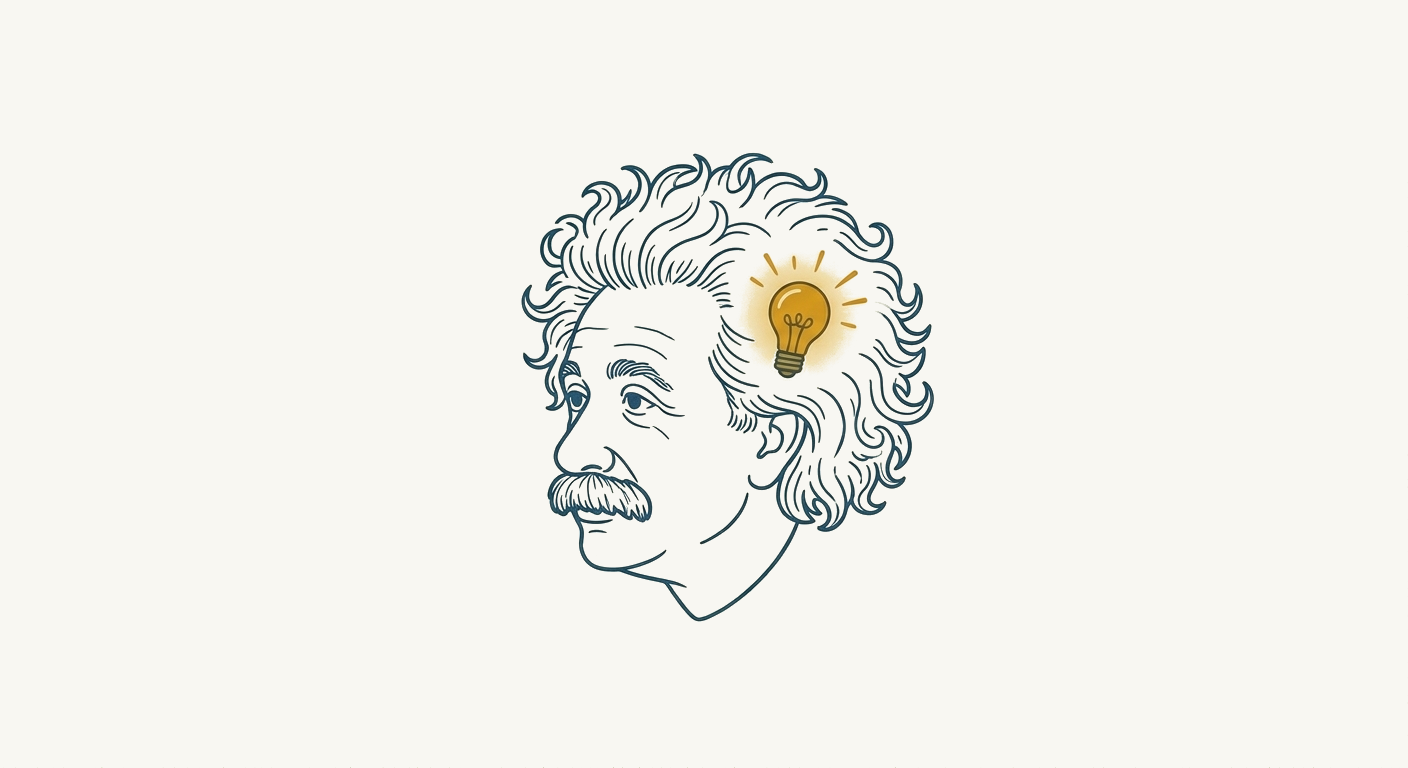
The Number Everyone Cites, and Why It's Complicated
Albert Einstein's IQ is almost universally quoted at 160. It appears in textbooks, listicles, and motivational posts. There is one significant problem: Einstein never took an IQ test.
The modern IQ test, in the form we recognise today, was developed largely after Einstein's most productive years. Einstein died in 1955. The Wechsler Adult Intelligence Scale, the most widely used clinical IQ instrument, was first published in 1955. The overlap was minimal and there is no record of Einstein completing a formal cognitive assessment.
Discover Your IQ Score
Free 36-question assessment. Instant results. No sign-up required.
Take the Free IQ Test →Where Does the 160 Figure Come From?
The 160 estimate comes from retrospective analysis, psychologists and historians examining Einstein's academic output, problem-solving style, and published work, then mapping it to an approximate IQ equivalent. Psychologists call this retroactive estimation, reading the work someone left behind and working backwards to guess what they might have scored.
It is an educated estimate, not a measurement. The margin of error on such estimates is typically ±20 points or more, meaning the honest range is somewhere between 140 and 180+.
The formal name for this approach is historiometry, a method developed and refined by psychologist Dean Simonton at UC Davis. Simonton's work on historical genius codes biographical records for specific markers: age at first creative work, speed through formal education, complexity of published output, breadth of contribution. These coded variables are then compared against living subjects with known IQ scores to produce an estimate. It is more rigorous than a journalist guessing, but it is still a model built on proxies. Simonton himself is careful to present these figures as distributions, not data points. A range of 140 to 170 for Einstein would represent the field's actual consensus, not 160 exactly.
What Einstein's Actual Cognitive Profile Looked Like
What we do know about Einstein's cognition is more interesting than a single number:
- He was a visual-spatial thinker who described arriving at the theory of special relativity by imagining riding alongside a beam of light, a thought experiment, not a calculation.
- He was notably slower in formal academic settings than many peers. He failed the entrance exam to the Swiss Federal Polytechnic on his first attempt.
- His verbal and language skills in childhood were delayed, he did not speak fluently until age 4.
- He described his thinking as occurring in images and sensations first, with words coming second.
This cognitive profile, exceptional spatial-visual reasoning, uneven formal academic performance, late language development, does not map cleanly onto a single IQ score. It maps onto a specific kind of mind that conventional testing was not designed to capture.
What Happened to Einstein's Brain
When Einstein died in Princeton in April 1955, the pathologist who performed the autopsy, Thomas Harvey, removed the brain without family consent and kept it. What followed was genuinely strange: Harvey transported it in a cardboard box, distributed sections to various researchers over the following four decades, and eventually returned the remaining pieces to Princeton in 1998. The full story reads more like a dark comedy than a chapter of neuroscience history.
What the studies found was unexpected. Einstein's parietal lobes, the regions most associated with mathematical processing and spatial reasoning, were roughly 15% wider than average. A groove called the Sylvian fissure was partially absent in his parietal region, which researchers proposed may have allowed neurons across that area to communicate more freely. Whether this directly explains his particular form of genius is impossible to say with confidence; brains are not that readable. But the physical evidence points in the same direction as everything else we know about him: exceptional spatial-visual processing, an atypical language processing pattern, a cognitive profile that was genuinely unusual rather than simply very high on a single scale.
What This Means for How We Think About IQ
Einstein is actually a good argument for the limitations of IQ as a single-number summary of intelligence. He would almost certainly have scored exceptionally on any formal test. But his specific genius, the capacity for sustained abstract visualisation over years of solitary thought, is exactly the kind of ability that gets averaged out in composite scores.
The setting where his best work happened also matters. Einstein developed special relativity not at a prestigious university but while working as a technical examiner at the Swiss Patent Office in Bern. He spent his days evaluating mechanical devices, and his evenings thinking. No supervisor, no research group, no institutional pressure to publish. The ability to hold an unsolved problem in mind for years without external pressure, to resist the urge to publish early or move on, is not something any IQ test asks about. It may be the most important cognitive trait he had.
The 160 figure is a reasonable ballpark. It probably captures something real about how far above average his reasoning ability was. But it compresses a very specific and unusual mind into a comparison with standardised test performance, and in doing that, it loses most of what made him interesting. For a deeper look at the different types of intelligence and how they are measured, see our guide to fluid vs crystallised intelligence. If you want to understand what a score of 160 means in practice, the full profile covers what it predicts, which careers cluster there, and which contemporary figures have been estimated at that range.

AJ Dorey
Founder, IQScore
AJ Dorey is an English software developer who researches and writes about intelligence and cognition. He built IQScore because most online IQ tests are broken — they either inflate scores to keep people happy or bury results behind a paywall after 20 minutes of questions.
Further Reading
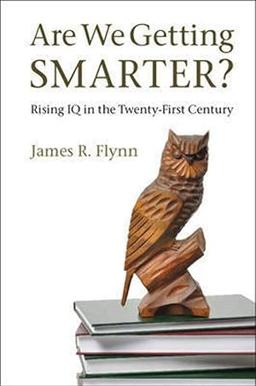
Are We Getting Smarter?
James Flynn
Are We Getting Smarter? by the researcher who documented the Flynn Effect is the most rigorous popular account of what IQ scores actually measure, and what historical figures like Einstein can and cannot tell us about raw intelligence.
Curious where you actually rank?
Free IQ test · 36 questions · Instant results · No sign-up
Start Free IQ Test →Already know your score? Convert it to a percentile →