
Two Measures, Two Different Things
IQ and GPA both get used as proxies for intelligence, but they are measuring different things, and they predict different outcomes. Understanding the distinction matters if you are trying to assess your own cognitive profile, plan an academic or career path, or simply make sense of your scores.
What IQ Measures
IQ tests measure fluid reasoning, the capacity to solve novel problems, identify patterns, and process information quickly. They are intentionally designed to minimise the influence of prior knowledge and schooling. A well-constructed IQ test should produce similar scores whether or not you attended school, all else being equal.
This makes IQ a relatively stable trait. Research consistently shows that IQ scores correlate strongly across decades, people who score high at 20 tend to score high at 60.
Discover Your IQ Score
Free 36-question assessment. Instant results. No sign-up required.
Take the Free IQ Test →What GPA Measures
GPA measures a combination of cognitive ability, conscientiousness, motivation, time management, and the ability to navigate specific institutional environments. Two students with identical IQs will typically produce different GPAs based on effort, study habits, and engagement.
GPA is far more malleable than IQ. It responds to deliberate effort, effective study strategies, and consistent behaviour over time. It also reflects specific content knowledge, a student with a high IQ who never studies will produce a lower GPA than a moderately intelligent student who works systematically.
There's a slightly counterintuitive finding in the conscientiousness research: IQ and conscientiousness tend to be weakly negatively correlated at higher ability levels, around -0.10 to -0.15. Highly intelligent people are, on average, marginally less conscientious than those of average intelligence. Small effect, but it helps explain the pattern teachers recognise immediately: the student who clearly understands the material but won't turn in the work. High IQ doesn't automatically produce the self-regulation needed to translate ability into grades.
Which Predicts Career Success?
Why These Studies Are Trickier Than They Look
Most IQ-GPA comparisons draw on university student samples, which is already a filtered group. The average IQ at a selective university sits around 115, not 100. When you're comparing people who are all cognitively capable, IQ differences become less meaningful and conscientiousness differences become more visible. Studies that use this population tend to show IQ and GPA as roughly equal predictors of academic outcomes, which understates what happens across the full population range.
Grade inflation complicates things further. Average GPAs at US universities rose from roughly 2.8 in the 1960s to around 3.4 today, without any corresponding increase in measured ability. The top quartile is increasingly compressed above 3.7, making GPA a weaker fine-grained signal. Recruiters know this, which is partly why standardised test scores came back into fashion at major consulting and finance firms that had quietly dropped GPA cutoffs in the early 2010s.
Job performance research has the opposite problem: it often can't test employees' IQs directly, so researchers use proxies, years of education, old entrance scores, verbal ability screenings, which correlate with IQ but imperfectly. This typically underestimates how strongly IQ predicts performance. Schmidt and Hunter's 1998 meta-analysis, which synthesised nearly 500 studies across 85 years of research, put the validity of general mental ability at 0.51 for predicting job performance in complex occupations. Nothing else came close. Not personality tests. Not education level. Not unstructured interviews.
The Honest Summary
If you have a high IQ and a low GPA, you likely have the raw cognitive ability but have not yet developed the work habits and conscientiousness to translate it into performance. This is fixable, and the research on deliberate practice suggests it is highly responsive to structured effort.
If you have a high GPA and a modest IQ, you have demonstrated something valuable: the ability to consistently produce results through sustained effort. This predicts a great deal about your career trajectory.
Career type matters too. IQ predicts most strongly in roles that require handling novel, complex information under uncertainty, medicine, research, law, engineering. In roles that are more procedural or relationship-driven, conscientiousness and interpersonal skill predict outcomes about as well as IQ does. A high-IQ, low-GPA person should probably think carefully about whether the career they're targeting actually rewards the kind of thinking they're good at, rather than assuming raw ability will eventually cover for the rest.
The most successful profile, unsurprisingly, combines both. To understand what your specific IQ score means for career fit and percentile rank, see the full IQ score guide →

AJ Dorey
Founder, IQScore
AJ Dorey is an English software developer who researches and writes about intelligence and cognition. He built IQScore because most online IQ tests are broken — they either inflate scores to keep people happy or bury results behind a paywall after 20 minutes of questions.
Further Reading
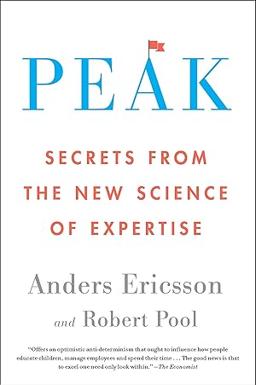
Peak: Secrets from the New Science of Expertise
Anders Ericsson
Peak is the definitive research on deliberate practice, the mechanism that explains why GPA (effort over time) so often outperforms raw IQ in real-world career outcomes, and how to actually develop the skills that matter.
Curious where you actually rank?
Free IQ test · 36 questions · Instant results · No sign-up
Start Free IQ Test →Already know your score? Convert it to a percentile →