The Attention Span Myth
You have probably seen the statistic: humans now have an average attention span of 8 seconds, shorter than a goldfish. It is cited in corporate presentations, wellness articles, and education debates. It is also almost entirely fabricated, traced back to a 2015 Microsoft marketing document that itself cited a non-existent Canadian study.
The concept of a universal "attention span" duration is neurologically incoherent. Attention is not a fixed resource that runs down on a timer. It is a dynamic cognitive function with multiple distinct components, each with different characteristics, limitations, and determinants. Understanding what attention actually is has practical implications for cognitive performance that the goldfish myth entirely misses.
The Components of Attention
Attention is better understood as four partially distinct systems:
Sustained attention, maintaining focus on a continuous task over time. This is what most people mean by "attention span." It degrades with fatigue, boredom, and reduced signal value. A person who cannot focus for five minutes on something tedious may sustain three hours of focus on something genuinely engaging.
Selective attention, filtering relevant from irrelevant stimuli. This is where the environment matters most. High-distraction environments (open offices, notification-heavy devices) impose a continuous selective attention tax even when you are not consciously distracted.
Divided attention, processing two streams simultaneously. Human capacity for true simultaneous processing is limited; what most people call "multitasking" is rapid task-switching with an associated cognitive cost at each switch.
Executive attention, directing and regulating the attentional system itself. This is the highest-order component, tightly linked to working memory and the prefrontal cortex. It is what lets you override an automatic response, maintain a goal in mind while executing a subtask, and return to a primary task after an interruption.
23 min
Average time to fully regain focus on a complex task after a single interruption (Mark et al., UC Irvine)
Discover Your IQ Score
Free 36-question assessment. Instant results. No sign-up required.
Take the Free IQ Test →What Has Actually Changed
Something has changed about how people manage attention in modern environments, just not what the goldfish statistic claims. Gloria Mark at the University of California, Irvine has tracked workplace self-interruption patterns for two decades. Her data shows that the average time people spend on a digital task before switching dropped from around 2.5 minutes in 2004 to around 47 seconds by 2020. People are not losing the capacity to focus, they are interrupting themselves far more often, and the cost of each interruption is substantial.
A separate thread of research from Killingsworth and Gilbert, published in Science in 2010, found that the human mind wanders approximately 47% of the time during waking hours, regardless of what the person is doing. Mind-wandering was correlated with reduced happiness independent of the activity, but it is also a form of task-independent thinking that can support creativity and planning. The problem is not that minds wander; it is that modern devices have made self-interruption during intended focus periods much easier and more rewarding in the short term.
Attention as a Cognitive Performance Predictor
Across cognitive assessments, executive attention is one of the strongest predictors of performance. The mechanism is direct: most complex cognitive tasks require holding information in working memory while performing operations on it. That process requires sustained executive attention. Any degradation in the attentional system degrades working memory, which in turn degrades problem-solving, reasoning, and comprehension.
This is why sleep deprivation affects IQ test scores: the primary mechanism is attentional degradation, not a direct loss of reasoning capacity. A well-rested person performing a matrix task can sustain the focused processing needed to work through complex rule inference. The same person sleep-deprived may have the same underlying reasoning capacity but be unable to maintain focus long enough to deploy it effectively.
What Degrades Attention
- Sleep deprivation, the single most potent acute impairment. Even partial sleep restriction (6 hours per night for two weeks) produces attentional deficits equivalent to two full nights of total sleep deprivation
- Chronic stress, cortisol reduces prefrontal cortex activity and impairs executive attention specifically
- Digital notifications, even the presence of a phone face-down on a desk measurably reduces available cognitive capacity in working memory tasks
- High cognitive load environments, sustained periods of switching between unrelated tasks deplete the executive attention system
- Poor physical health, inflammation, metabolic dysfunction, and cardiovascular deconditioning all affect cerebrovascular perfusion and attentional function
What Strengthens Attention
The evidence here is cleaner than for many cognitive interventions:
- Meditation and mindfulness training, meta-analyses consistently show improvements in sustained and selective attention from as little as 8 weeks of regular practice
- Aerobic exercise, well-documented improvements in executive attention, likely mediated by BDNF (brain-derived neurotrophic factor) and prefrontal cortex blood flow
- Structured deep work periods, training the habit of extended uninterrupted focus strengthens the capacity for it, consistent with evidence on attentional skill development
- Sleep consistency, not just total duration but circadian regularity appears to matter for sustained attention
Practical Implications
If you found your attention drifting during a cognitive assessment, the cause is more likely to be one of the impairment factors above than an inherent attentional limitation. Most people who struggle with attention on demand are experiencing an attentional environment problem or a physical state problem, not a fixed attentional capacity ceiling. The ceiling, where it exists, is much higher than goldfish mythology suggests.

AJ Dorey
Founder, IQScore
AJ Dorey is an English software developer who researches and writes about intelligence and cognition. He built IQScore because most online IQ tests are broken — they either inflate scores to keep people happy or bury results behind a paywall after 20 minutes of questions.
Further Reading
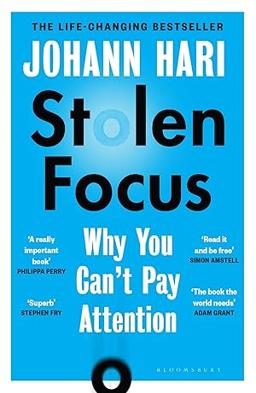
Stolen Focus
Johann Hari
Stolen Focus is a deeply researched investigation into why attention is collapsing and what can realistically be done about it. If this topic concerns you, it's one of the most important reads of the last few years.
Curious where you actually rank?
Free IQ test · 36 questions · Instant results · No sign-up
Start Free IQ Test →Already know your score? Convert it to a percentile →