What a Study of 26,000 People Actually Found
Researchers at Imperial College London analysed cognitive test data from 26,000 adults and found a consistent pattern: people who identify as evening types (those who naturally prefer staying up late and waking later) outperformed morning types across multiple cognitive domains. The advantage ranged from 7.5% to 13.5% depending on the task, published in BMJ Public Health in 2024.
That is not a rounding error. After controlling for age, sex, education level, and total sleep duration, the effect held. We found this harder to dismiss than earlier, smaller studies on the same question.
The domains where evening types pulled ahead included working memory, reasoning speed, and abstract problem-solving. These are not peripheral cognitive skills. They are exactly what IQ tests are designed to measure.
7.5–13.5%
Cognitive performance advantage for evening chronotypes over morning types, Imperial College London, 2024 (N=26,000)
What Chronotype Actually Means
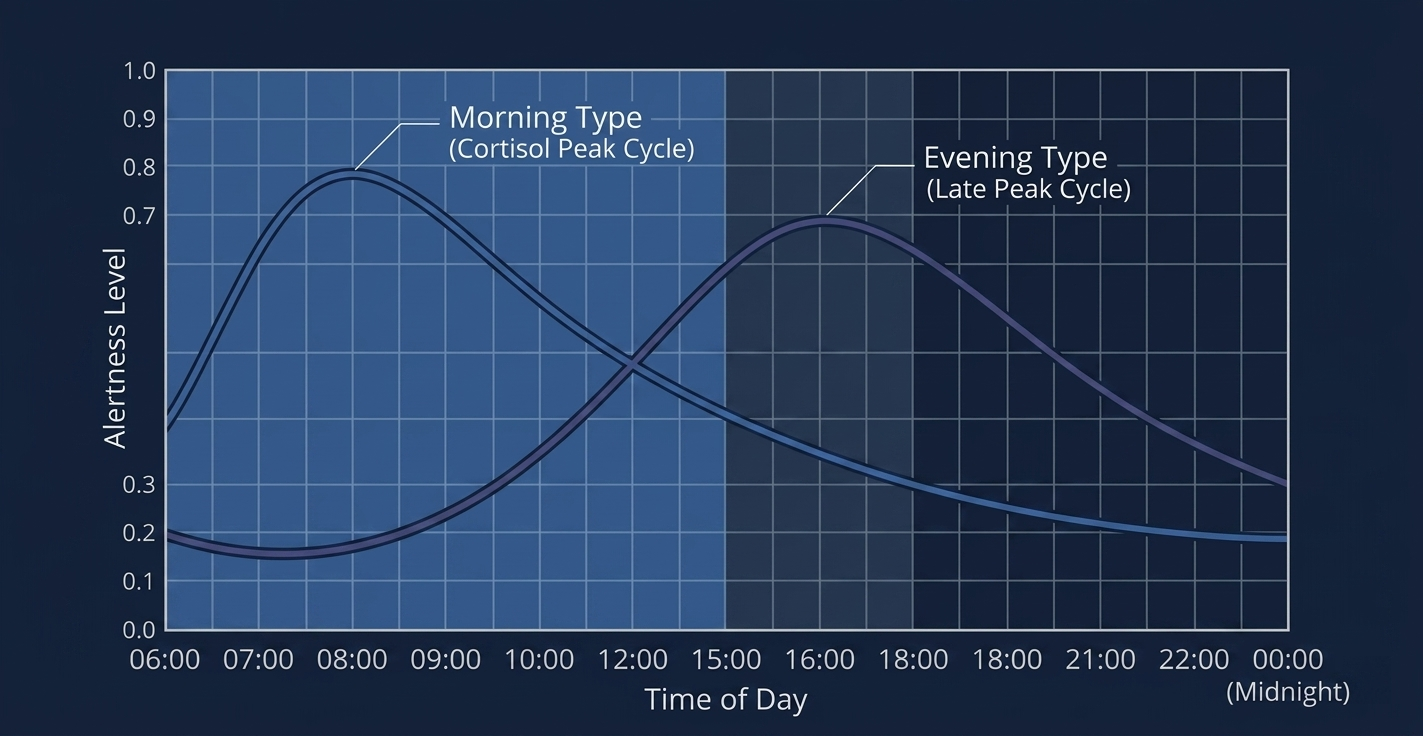
Chronotype is your biological tendency toward a particular sleep-wake timing. It is not willpower or discipline. It is driven largely by genetics, large-scale genetic studies have identified over 350 variants linked to sleep timing, meaning your body clock is substantially inherited. Telling a night owl to "just get up earlier" is about as effective as telling a morning person to perform at their best at 2am. Both are fighting their own biology.
An evening chronotype reaches peak alertness several hours later than a morning type. Their body temperature peaks later. Cortisol rises later. Melatonin drops later. The entire biological clock is shifted to later hours in the day. This is not a preference, it is physiology.
Chronotype also shifts across the lifespan. Children tend toward mornings. Adolescents shift dramatically toward evenings during puberty, then gradually shift back as they age through their twenties and thirties. By middle age, most people have drifted back toward an intermediate type. The strongest evening chronotypes are typically found in the 18–30 age range.
Discover Your IQ Score
Free 36-question assessment. Instant results. No sign-up required.
Take the Free IQ Test →The Finding That Surprised Us Most
Most cognitive studies, including the Imperial College one, are conducted during standard working hours. Morning hours. For evening chronotypes, this is the equivalent of asking a morning person to sit a test at midnight.
Their brains are not at operating temperature when the test starts. They are underperforming relative to their actual capacity. And yet they still outperform morning types by up to 13.5%.
If evening types score that much higher when tested at a time that actively disadvantages them, the underlying cognitive difference at each person's optimal time of day is almost certainly larger. We do not know the true gap. Nobody has run that study properly. But it is the obvious follow-up question, and the fact that no large study has addressed it directly is a gap in the literature worth naming.
The Biology Behind It
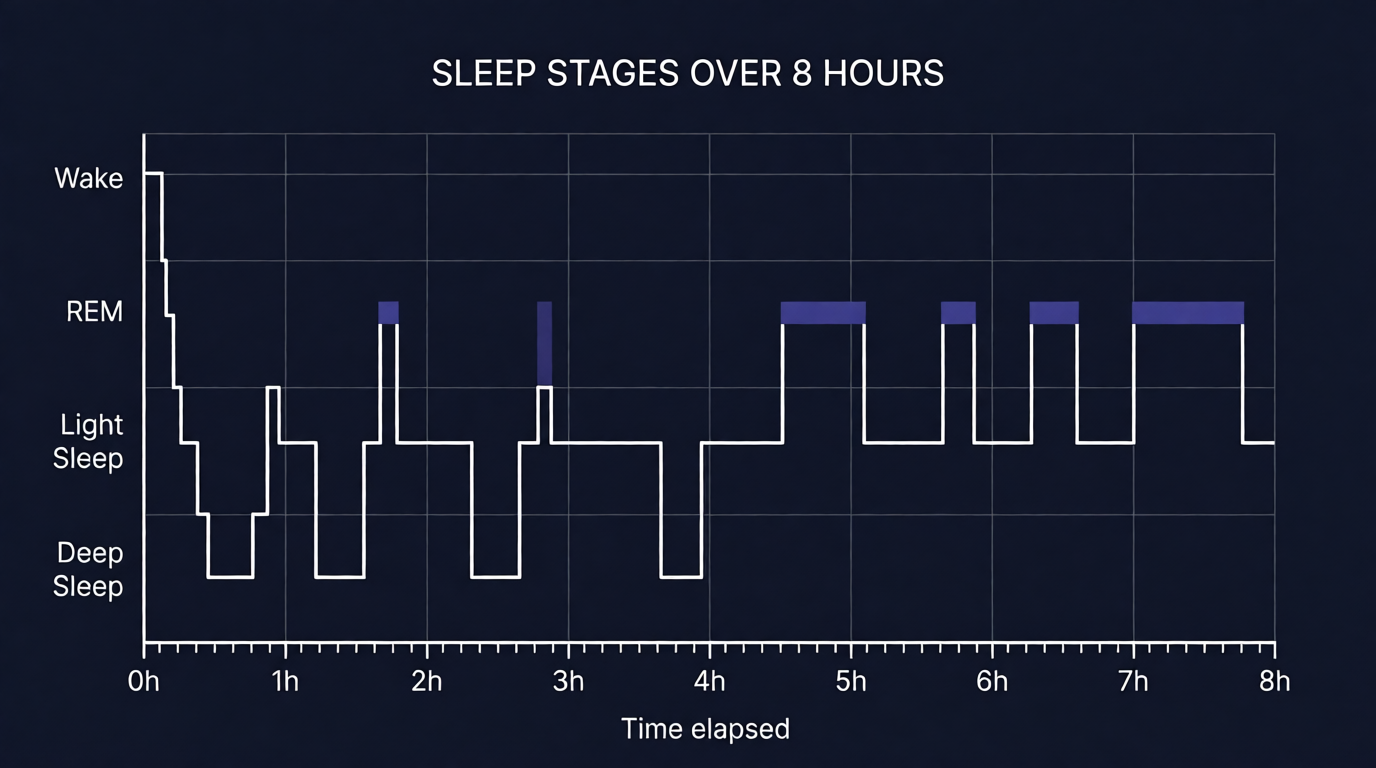
Two mechanisms are worth understanding. First, REM sleep (the phase most closely linked to memory consolidation, abstract reasoning, and creative problem-solving) is concentrated in the later portion of the sleep cycle. Someone sleeping from 1am to 9am gets proportionally more REM than someone sleeping from 10pm to 6am, because REM pressure builds as sleep progresses. Evening chronotypes, sleeping on their natural schedule, may consistently get more of the cognitively restorative sleep phases. The cognitive cost of disrupting this is well documented.
Second, the prefrontal cortex, the brain region responsible for working memory, reasoning, and decision-making, does not hit full capacity immediately after waking. It ramps up. For morning types, this ramp peaks around 9–10am. For evening types, the same peak arrives in the mid-to-late afternoon, sometimes later. Testing both groups at 9am is not a controlled comparison, it is systematically testing one group at peak and the other well short of it.
What This Does Not Mean
Staying up late does not make you smarter. The direction of causation here is probably the opposite of what most headlines imply.
Higher general intelligence tends to correlate with openness to experience, engagement with stimulating ideas, and late-night reading and exploration. These behaviours gradually shift chronotype later over time. Intelligence may shape evening preference, rather than evening preference shaping intelligence. The study cannot separate these two directions from observational data alone, and we should not pretend it can.
There is also a selection effect. Evening types who participate in general population studies tend to be younger and more educated on average than the broader pool of morning types. Some of the cognitive advantage in the data may reflect those demographic differences rather than chronotype itself. The Imperial College team controlled for several of these variables, but there are influences that even careful methodology cannot fully account for.
The honest read: evening preference correlates with higher cognitive scores, the relationship probably runs both ways, and the causal story is more complicated than "night owls are smarter."
The Sleep Penalty Night Owls Pay
Most institutions run on morning schedules. School starts early. Standard jobs start early. Cognitive assessments are administered in the morning. Evening chronotypes living in this structure experience what sleep researchers call social jetlag, a chronic misalignment between their biological clock and their actual schedule.
The result is that many night owls are functionally sleep-deprived, not because they sleep badly, but because they are forced to wake before their circadian system is ready. A night owl who needs to be awake at 7am but cannot fall asleep before 1am is operating on six hours regardless of how well they sleep in that window. The cognitive cost builds.
This creates a real-world paradox. Evening types may have higher cognitive capacity, but social jetlag means many of them operate below that capacity on a daily basis. The 7.5–13.5% advantage seen in the research might represent a floor rather than a ceiling for those who can actually sleep on their own schedule.
What It Means If You Are Taking a Cognitive Test
Timing matters more than most people realise. If you take an IQ test when your brain is not running at capacity, your score will understate your actual ability. This is true for everyone, but it is a larger problem for evening chronotypes who test in the morning.
If you know you are an evening type, testing at 2pm or later will almost always give a more accurate picture than testing at 9am. Your working memory will be fuller. Your processing speed will be higher. Your abstract reasoning will be sharper.
One way to check whether you are at your cognitive peak before starting: take a reaction time test. Reaction time is one of the most sensitive real-time measures of how alert your nervous system currently is. If your times are noticeably slower than usual, your brain has not fully come online yet. That is a signal worth acting on before committing to a full assessment.
If you are an evening person and you have always tested in the morning, you may have spent years underestimating yourself. That is worth knowing.

AJ Dorey
Founder, IQScore
AJ Dorey is an English software developer who researches and writes about intelligence and cognition. He built IQScore because most online IQ tests are broken — they either inflate scores to keep people happy or bury results behind a paywall after 20 minutes of questions.
Curious where you actually rank?
Free IQ test · 36 questions · Instant results · No sign-up
Start Free IQ Test →Already know your score? Convert it to a percentile →